 Caregiver Stories
How one care manager champions patient advocacy from “hello”
No one wants to be admitted to a hospital. But when it’s necessary, our care/case managers step in, ready to ensure patients get exactly the support they need—no more, no less—and can get back to their lives as quickly and safely as possible. We recently spoke with Care Manager Cheyenne about her path into the field, what makes the work so rewarding, and why she loves being part of the Providence team in Santa Monica.
Cheyenne’s path from social work to care management
Cheyenne’s journey started with a deep interest in healthcare and helping others. She began as a resident care assistant supporting patients with dementia. When she was admitted to UCLA, she was able to pursue a Master of Social Work degree, which led to an internship at Providence. That internship eventually turned into a full-time role. “I felt very blessed,” says Cheyenne.
Now, four years later, Cheyenne thrives in a role she describes as “an ever-evolving learning experience. You’re constantly being challenged, and you’re constantly learning new things about the job and yourself.”
The care manager role: “Discharge planning starts as soon as they’re admitted.”
When a patient is admitted to one of our 3,475 staffed hospital beds in California, Cheyenne her fellow California-based care/case managers leap into action, with an eye toward what steps need to happen for a safe and timely discharge right from the first interaction. “I start planning as soon as I do my initial assessment with the patient,” says Cheyenne.
Her typical day begins by reviewing her assigned cases—usually around 15-20 patients, primarily in ICU telemetry. Then, she attends a morning meeting with the entire care team to map out a plan for the day. “You have all the case managers, your director and manager of case management, all of the charge nurses, our physician advisor, sometimes the CNO or homeless coordinators, and all of the doctors in one big room every morning,” says Cheyenne. This creates a powerful network to ensure world-class care for every patient.
The rest of Cheyenne’s day is spent working to fulfill that plan: communicating with long-term care facilities, arranging transportation for patients who will be transferred for additional support, obtaining assessments from physical and occupational therapists, communicating with insurance companies, and ensuring that the patients and their families understand and agree to the plan—as well as answering any questions they have about paid leave, health insurance and much more.
While care managers work autonomously on their own cases, Cheyenne says the environment at Providence is highly collaborative. She explains that she never feels like she’s working alone, saying, “We’re always calling each other or going to each other’s office to ask questions or share ideas.”
When asked what she likes most about working at Providence, she smiles and says, “Honestly, it’s the people. I love my team. They’re really like a family to me.”
Growth and professional development from day one at Providence
Cheyenne says she’s been encouraged to grow in her career and has felt supported along the way. Her former internship supervisor remains a mentor as she works toward the 3,000 hours of supervision needed to obtain her Licensed Clinical Social Worker (LCSW) certification.
“My leadership brought on an LCSW to make sure that people can get their hours here,” she explains. “There’s always room for people to improve on their education and work toward their goals.”
As someone with an advanced degree, Cheyenne also appreciates that Providence, as a nonprofit organization, is a qualifying employer for the Public Service Loan Forgiveness program, which can forgive student loan debt for caregivers who have made 10 years of qualifying payments. She says it’s a significant benefit that will ease her financial burdens and support long-term career stability.

A culture that supports her wellbeing
Caring for patients and their families is demanding work, but Cheyenne says Providence has a culture that values work-life balance. “I feel like my manager and director really try to make sure that we have time for ourselves at home,” she says. “They encourage us not to stay overtime, to hand things off to the after-hours person and go disconnect and recharge.” This structure, along with Cheyenne’s predictable schedule from 8 a.m. to 4:30 p.m. each weekday, allows her to “leave work where it is.”
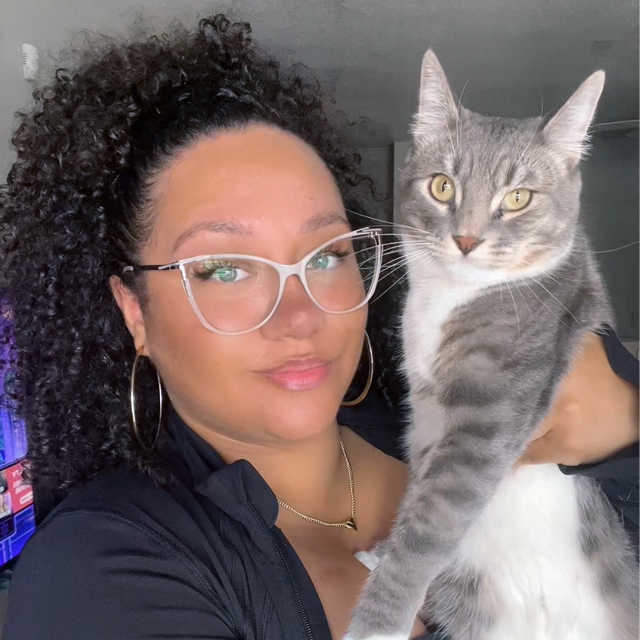
Recharging often means heading directly to the beach to watch the sunset over the Pacific Ocean, then carpooling home with coworkers and snuggling with her cat, Sailor, a 1-year-old tabby. “She brings me joy,” Cheyenne says. It’s these moments of peace that allow her to bring her best self to work each day.
The reward of working as a care manager at Providence
For Cheyenne, the most rewarding part of being a care manager is the direct impact she has on patients and their families during a stressful time. She finds satisfaction in advocating for her patients and guiding them to the next level of care.
“It’s really rewarding to hear from the patients and sometimes the family like, ‘Thank you so much for your hard work and your advocacy because you know, it wouldn’t happen without you,” she shares.
She recalls one young patient who was hesitant about being transferred to a long-term acute care facility. A few months later, he returned to the hospital simply to express his gratitude. Says Cheyenne, “He actually came back to thank us for everything that we did—on his birthday!”
Find your place at Providence in Southern California
If you’re a nurse or social worker interested in care/case management, Cheyenne has simple advice: “Be open to learning, open to constructive feedback. And really, just don’t be afraid to ask questions and be a beginner at something. That’s how you can grow as a person.”
Ready to take the first step? See care/case manager roles in California.