 Caregiver Stories
Imaging careers that put technology to work for patients
As medical imaging continues to advance, so do the opportunities to grow your career. The right role can give you new ways to apply your skills, work with evolving technology and make a meaningful difference for patients.
At Providence, that can mean providing MRI guidance during brain surgery, bringing ultrasound to the bedside, using AI-enabled PET technology or supporting complex procedures with advanced interventional imaging. Across these specialties, sophisticated technology and human expertise come together to help teams see more, work with greater precision and care for patients in new ways.
Hear from our Providence Swedish caregivers about the technology and clinical work that keep them learning, collaborating and moving imaging forward.
MRI: Bring technical precision to complex cases
At Providence, MRI technology takes technologists beyond the scanner and, in some cases, into the operating room.
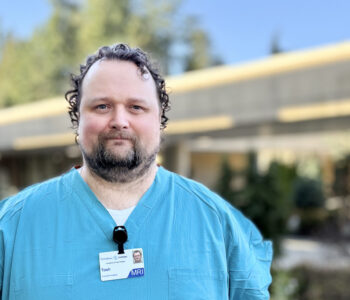
“We do guided biopsies and have an intraoperative MRI here as well, meaning we get to assist in brain surgeries. We get to be in the OR with brain surgeons and provide MRI imaging guidance during tumor removals,” says MRI Technologist Vitaliy.
For Vitaliy, the fascination also lies in what advanced imaging can reveal.
“We get to see the activation sites and the areas of the brain that basically make people tick,” he says.
It’s a setting where technical precision meets highly specialized care, giving technologists opportunities to apply their skills on complex cases and work alongside multidisciplinary teams.
And the field continues to advance. Industrywide, innovations such as AI-based deep learning are creating new approaches to image reconstruction, while wider-bore scanners are designed to give patients more space without sacrificing image quality.
Ultrasound: Put your judgment to work at the bedside
With ultrasound, some of the most valuable innovation is the ability to bring sophisticated imaging directly to the patient.
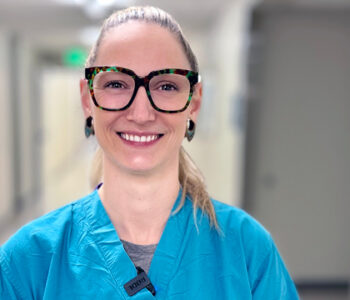
“I really liked ultrasound because it was safe and portable. We get to go to the patient in a lot of cases,” says Ultrasound Technologist Kaelee.
But portability is only part of the story. Sonographers bring their own expertise to every exam, assessing what they see and working closely with radiologists to provide the information needed for interpretation.
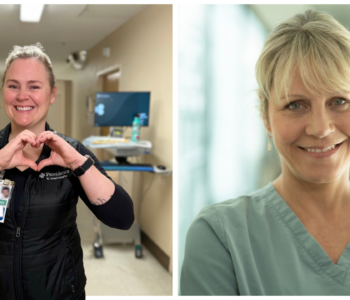
Ultrasound Technologist Megan describes that partnership: “We actually are expected to know what we are looking at, and we write in-depth reports for the radiologists. We work very closely with them.”
That combination of technology and judgment becomes even more interesting as the field evolves. AI-guided scanning can assist with anatomy recognition and probe positioning, handheld devices continue to expand portable imaging, and automated measurements can reduce repetitive steps.
For sonographers, these advances create new tools for a role that still depends on something technology can’t replace: knowing what you’re seeing and what to do next.
PET: Use smarter technology to improve the imaging experience
Innovation matters when it changes what a technologist can do. It matters even more when the patient can feel the difference.
PET Technologist Ally experiences both with a newer scanner at Providence Swedish.
“Our new scanner has an AI positioning camera, so the patient just lies down, and the camera knows exactly where they are and puts them in the right place,” she says.
Capabilities like these can streamline positioning and support shorter scan times, creating a more efficient workflow while making the experience easier for patients.
Across the field, PET continues to push forward. Total-body scanners are enabling greater sensitivity, with the potential for shorter scans or lower radiation doses, while AI-based image reconstruction can reduce noise and improve image quality. Hybrid PET/MRI systems are also bringing molecular and detailed soft-tissue imaging together.
At the center of those advances is the technologist who knows how to put sophisticated technology to work while keeping the individual patient at the center of the exam.
Interventional imaging: Put advanced imaging to work in real time
In interventional radiology, imaging doesn’t just inform what happens next. It can become part of the procedure itself.
At Providence Swedish, Lead IR Tech Tyler works with advanced CT capabilities that allow imaging information to move with the care team into the procedural environment.
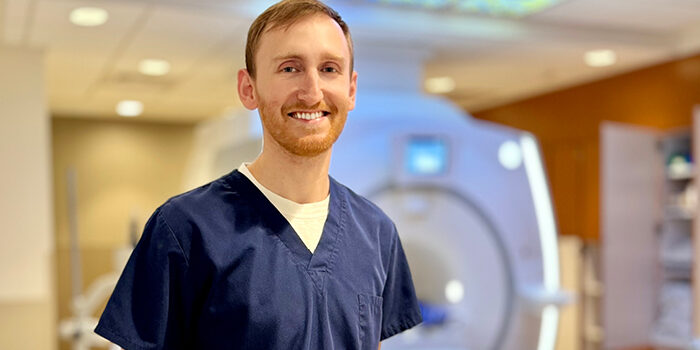
“We can bring them in the operating room and use that information, build it into the machine, to reference when we’re operating,” he says.
He also works with a biplane neuroimaging system that captures front and side X-ray views at the same time and gives the team a 3D-like view of blood vessels.
“You can get AP and lateral at the same time, do three-dimensional spins, fun things like that,” Tyler says.
It’s an environment where imaging expertise, advanced technology and multidisciplinary teamwork converge in real time.
And the possibilities continue to expand. Across interventional imaging, image fusion is bringing information from modalities such as CT, MRI and ultrasound together to guide procedures. Robotic assistance is being used for applications such as needle placement and catheter navigation, while augmented reality is being explored as another way to bring 3D imaging into the procedural environment.
Work in a field that keeps moving forward
Imaging technology doesn’t stand still. Neither do the people who build their careers around it.
From intraoperative MRI and AI-enabled PET positioning to portable ultrasound and sophisticated interventional imaging, new capabilities continue to change what’s possible. For technologists, that makes imaging a career of continued learning: new technology to understand, new applications to master and new ways to contribute to patient care.
What doesn’t change is the expertise behind it.
Technology can create extraordinary images and information. Turning those capabilities into excellent care still takes people with the clinical judgment to recognize what matters, the technical skills to get the most from the equipment and the ability to collaborate when the case becomes complex.
Bring your skills to what’s next
The best technology creates possibilities. Skilled technologists turn those possibilities into better experiences for patients and valuable information for care teams.
At Providence, you can bring the expertise you’ve already built to an environment where advanced imaging is part of the everyday work, from the bedside to the operating room.
And if you’re looking for a next step that keeps you close to where imaging is headed, there’s more here to explore.
Explore diagnostic imaging careers at Providence and find your next opportunity.